
By: Leigh-Ann van Strijp, Lead Patient Partnership
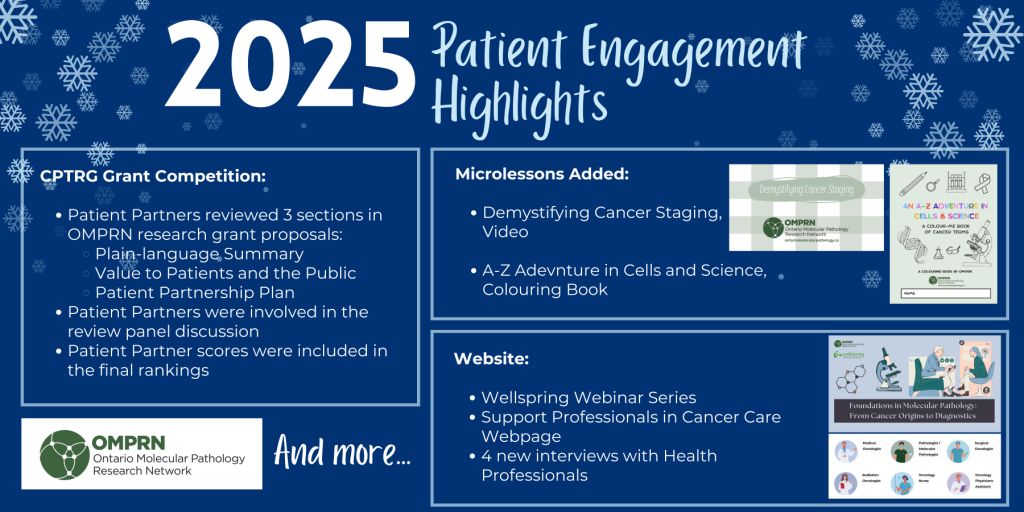
2025 has been a remarkable year for patient partnership at OMPRN. Across projects, resources, and outreach activities, patient partners played an essential role in shaping how OMPRN communicates molecular pathology education to the public.
This commitment was evident early in the year through our March webinar series delivered in collaboration with the Wellspring Cancer Support Foundation. As highlighted in our July newsletter, this four-part event brought together researchers, pathologists, and patients to discuss key molecular pathology topics, including how cancer develops, how molecular testing guides treatment, and the growing importance of patient involvement in care decisions. With over 100 attendees and outstanding feedback, the series set the tone for a year focused on meaningful engagement.
Building on this momentum, OMPRN proudly released several new molecular pathology microlessons, including the launch of A–Z: An Adventure in Cells and Science, our first-ever colouring book designed to introduce foundational cancer and cell biology concepts in a fun, approachable way for all ages. Alongside this, we released a new video, Demystifying Cancer Staging, which breaks down another commonly misunderstood area of cancer care. We upgraded our Support Professionals in Cancer Care webpage, highlighting the many individuals who contribute to a patient’s cancer care journey. Alongside this, we also added four new interviews with medical professionals to our library.
Throughout the year, OMPRN expanded its reach through multiple social media campaigns. These included our “mind map” resource series, helping followers navigate our growing library of public education tools and a “get to know our team” campaign, where we proudly featured not only OMPRN staff but also the patient partners who help guide our work.
A final highlight of 2025 was the CPTRG Grant Competition, where OMPRN expanded its patient partnership model by including patient partners directly on the review committee. Their role was to evaluate key components such as the plain-language summary, the value of the proposed research to patients and the public section, and the patient partnership plan. Their contributions enriched the review process and reinforced the meaningful role that patients play in research.
As the year draws to an end, OMPRN is proud of the progress made in strengthening patient engagement at every stage of our work. From education and communication to research evaluation and strategic planning, our patient partners have helped shape a more informed, inclusive, and patient-centered molecular pathology community. We look forward to continuing this momentum into 2026 and beyond.
Posted on: