
By Leigh-Ann van Strijp
Whether someone is navigating a cancer diagnosis or they just want to find out about advances in cancer research, information can be both empowering and overwhelming. Between internet searches, social media, news articles and personal stories, it can be difficult for the public to know which sources are reliable and which might unintentionally spread misinformation.
At OMPRN, we understand that patients, families and the public need more than just facts. They need information that is accurate, easy to understand and relevant to their situation. As molecular pathology and precision oncology continue to advance, new terms and novel technologies are increasingly discussed in media. For patients and their families, complex testing and inscrutable results can be especially challenging to interpret without support. That is why every resource we create is designed with a key goal in mind: to help patients and the public develop a clearer understanding of the science behind their care. Whether they are learning about biomarkers, genomic testing or reading a molecular pathology report, our educational resources are developed to complement, not replace, the guidance provided by their healthcare providers.
Collaboration, transparency and a commitment to putting useful knowledge first are essential to our education development process. From the earliest stages of development through to dissemination, OMPRN works with patient partners, scientific experts and healthcare professionals to ensure our resources are evidence-based, easy to understand and reflective of the real questions that patients and their families care about. We also recognize that everyone learns differently, which is why we create educational materials in a variety of formats, including infographics, videos, interviews, webinars and storybooks. By presenting information in accessible and engaging ways, we hope to make learning about molecular pathology less intimidating and more approachable.
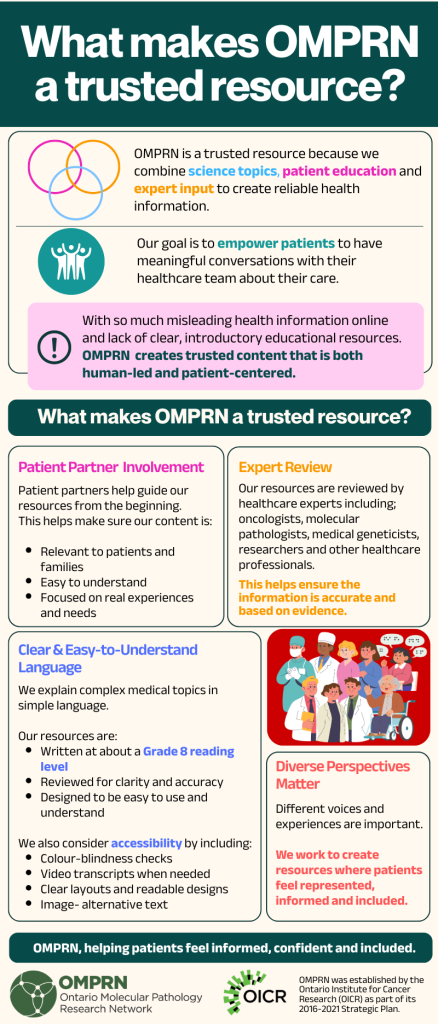
We created an infographic to highlight some of the key principles that guide everything we produce. Together, these elements help ensure that OMPRN remains a trusted source of molecular pathology education for patients, families, caregivers and healthcare professionals. As cancer care continues to evolve, so will the need for up-to-date, trustworthy educational resources. We would encourage you to consider how these principles might be applied to any of your own public-facing work.
Posted on: