
By Harriet Feilotter
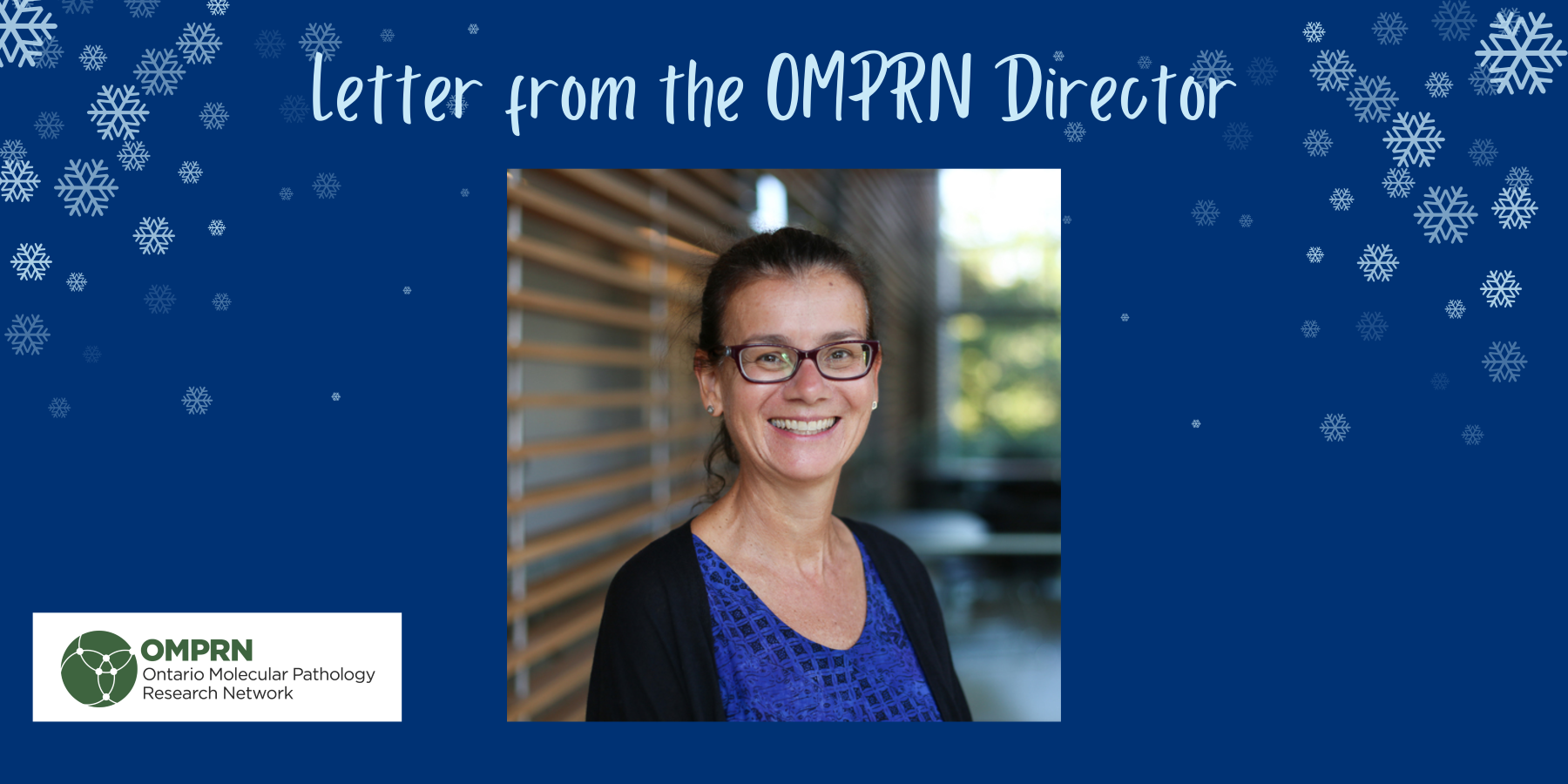
As 2025 draws to a close, it feels like the right time to pause, take a breath, and reflect on all that we have accomplished this year. OMPRN has remained focused on its usual three pillars of pathology-led research, education and networking, each of which has brought its own share of excitement.
On the research front, we resurrected the CPTRG competition for one more hurrah. You can find details of that endeavor later in this newsletter, but let me say how energizing it was to see such genuine enthusiasm for molecular pathology research in the network. We were very excited to have the opportunity to bring research dollars back to our members, and we greatly appreciated the high quality of the proposals that flowed in. While we only had sufficient funds to give the nod to a small proportion of these, the full set of applications offered a wonderful window into the types of molecular pathology research being pursued across Ontario. And while I’m on the topic of the grant competition, let me say a warm thank you to the experts who served on our review panels. These dedicated individuals put a lot of thought and effort into reviewing every submission, leading to excellent and thorough discussions of each one. In particular, our patient partners, Karen Haas and Terry Hawrysh, were tasked with reading each and every plain language summary and patient value statement, which was a Herculean task that they accomplished with characteristic insight and aplomb.
On the education and networking sides, OMPRN has been busy creating new learning resources and stretching further to reach more groups across the province. In March, we partnered with the Wellspring Cancer Support Foundation to deliver a four-part webinar series on the basics of cancer molecular pathology, drawing more than 100 participants. In September, we ran a lively interactive workshop on colon cancer at the Ontario Association of Pathologists (OAP) 87th Annual Conference – a special thank you to our wonderful presenters for this session: Melyssa Aronson, Dr. George Charames, and Dr. Aaron Pollett. We are also grateful to the OAP leadership for welcoming us as part of their conference program for 4 years running.
In true OMPRN fashion, the education pipeline kept flowing. This year, Leigh-Ann van Strijp led the development of A-Z: An Adventure in Cells and Science, a new colouring book created for kids dealing with cancer. This often-overlooked group of learners was overdue for something tailored to them, and they got lots of that with this funny and relevant ABC of cancer-related terms for kids. You can explore the colouring book and other new resources by clicking here.
While OMPRN had a great ride over 2025, this year also leads up to the culmination of the current OICR strategic plan. With the flurry of planning activities that accompanied the evolution of the 2026-2031 strategic plan, we had an opportunity to reflect on OMPRN’s growth, impact and our evolving role within the broader cancer research ecosystem. OMPRN has grown up well over the past 10 years of being a network for molecular oncology enthusiasts. It has provided countless opportunities for networking, built a substantial library of educational resources for all types of learners and has built a reputation as being forward thinking and innovative in the education and patient partnering space. On the research side, OMPRN has done a stellar job of supporting pathology-led research, a passion that had to be shelved with budget cuts in the last strategic plan cycle. Looking forward, we have asked ourselves what OMPRN still can and should do.
There remains much to accomplish in research and education in this space. At the same time, molecular pathology has become so deeply woven in cancer medicine today that confining our activities to a single network increasingly feels limiting. Instead, we have begun to consider how OMPRN’s core strengths of innovative education, networking, and collaborations in research can take place at the larger table of cancer medicine and research that is OICR. As OICR continues to establish itself as a provincial leader in early cancer detection, hereditary cancer, clinical trials, and implementation science, we see molecular pathology playing key roles in all of these undertakings. It seems a fitting time to allow the OMPRN to take its place as a core component of all that the OICR stands for.
Therefore, throughout the year to come, you will see elements of the OMPRN woven into the fabric of OICR’s plans. Watch for molecular pathology features in the grant programs rolling out from Clinical Translation. Notice the molecular pathology aspects of the hereditary cancer testing research and clinical programs as the Ontario Hereditary Cancer Research Network (OHCRN) continues its work. OMPRN’s molecular pathology expertise will play an increasingly important part in OICR’s Implementation Science program and the new Solutions Hub as we strive to bring cancer innovations to Ontario patients through our collaborations with Ontario Health.
OMPRN has had ten remarkable years as a standalone network, and we should all be proud of what we have built together. As OMPRN begins its next chapter, I hope you can share the same sense of excitement and optimism that I do. Thank you for being part of this journey and for helping OMPRN to grow into the dynamic voice it has become.
Wishing you all a restful and restorative end to the year and here’s to everything still ahead in 2026!
Posted on: